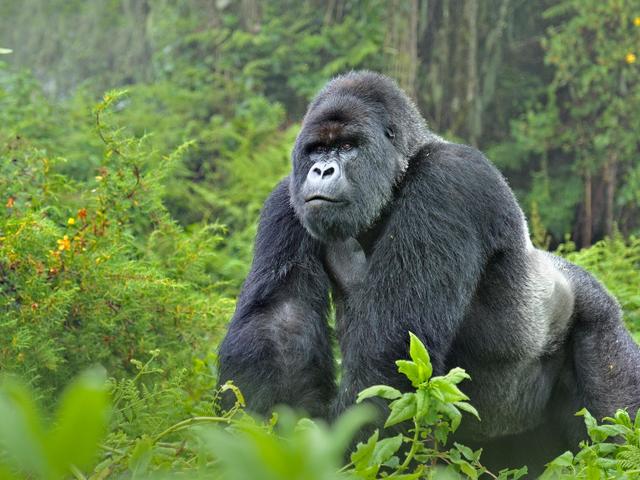
Gorillas


Gorillas are the largest of all the primates. A male gorilla can be 180 centimeters tall and can weigh 200 kilograms. Gorillas are very strong but they do not often fight. In fact they are peaceful animals.

Gorillas live in small family groups of about 15. In a group there is one strong, older male, some young males, and a few females with their babies. They move slowly around a large area of jungle eating leaves and bushes.

In some ways gorillas are very like humans. When they are happy, they laugh and wave their arms. When they are angry, they beat their chests. When they are sad, they cry. But they cry quietly, without any tears.

Unfortunately, people hunt and kill gorillas. They also cut down and burn their trees. There are now only about 10,000 gorillas left in the world.

(Source : Abbs, Brian, et.all. Take Off, Student Book 2, p 68)


Comments

Popular posts from this blog

Simple Present Tense

The simple present tense is one of several forms of present tense in English. It is used to describe habitual actions, unchanging situations, general truths, and fixed arrangements or schedules. The simple present uses the verb 1 (s/es): I eat; you eat; we eat; they eat; he eats; she eats; it eats. The simple present tense is used to express: 1. habitual actions He drinks tea at breakfast. She only eats fish. They watch television regularly. 2.   general truths Water freezes at zero degrees. The Earth revolves around the Sun. The earth is round. 3.   repeated actions or unchanging situations, emotions and wishes: We catch the bus every morning. Her mother is Peruvian. I love you. 4.        To give instructions or directions: Open the packet and pour the contents into hot water. You take the No.6 bus to Watney and then the No.10 to Bedford. Go to bed, it is 10.00 p.m. now. 5.        To express fixed...

Tsunami

  Tsunami, Japanese word meaning “harbor wave,” used as the scientific term for a class of abnormal sea wave that can cause catastrophic damage when  it  hits a coastline. Tsunamis can be generated by an undersea earthquake, an undersea landslide, the eruption of an undersea volcano, or by the force of an asteroid crashing into the ocean. The most frequent cause of tsunamis is an undersea earthquake. When the ocean floor is uplifted or offset during an earthquake, a set of waves is created similar to the concentric waves generated by an object dropped into the water. Most tsunamis originate along the Ring of Fire, a zone of volcanoes and seismic activity, 32,500 km (24,000 mi) long, which encircles the Ocean Pacific. Since 1819, about 40 tsunamis have struck the Hawaiian Islands. A tsunami can have wavelengths, or widths (the distance between one wave crest to the next), of 100 to 200 km (60 to 120 mi), and may travel hundreds of kilomet...

Describing People